CS 364 Network Security
Course Info
Network Security is a comprehensive hands-on course designed for IT professionals, network administrators, and anyone interested in enhancing their network security skills. Covering a broad spectrum of topics, from the basics of networking and TCP protocols to advanced topics such as firewall implementation and security, virtual private networks, and DNS attacks and protection, this course equips students with the knowledge and skills required to defend against network threats. Students will complete a project, present it to their peers, and participate in ‘Capture the Flag’ competitions to test their skills in a practical, hands-on environment.
Instructor:
Dr. Peilong Li
Office:
Esbenshade 284B
Appointments:
By email
Number of Credits
4
Pre-requisites
- CS 342 Computer Networks, and familiarity with Linux commands.
Textbooks
-
(Preferred) Wenliang Du. Internet Security: A Hands-on Approach. 3rd Edition. May 2022, Independently published, ISBN-13: 978-17330039-6-4.
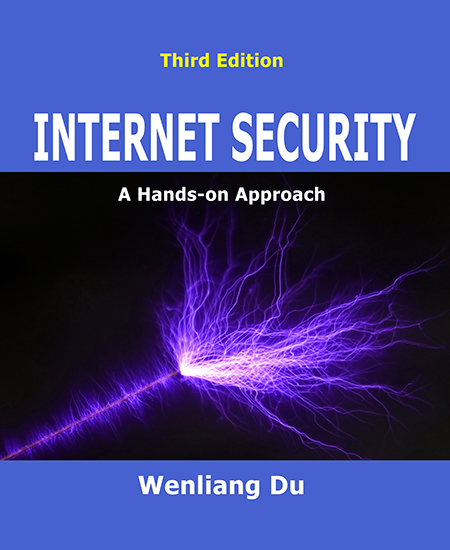
-
(OR) Wenliang Du. Computer & Internet Security: A Hands-on Approach. 3rd Edition. May 2022, Independently published, ISBN-13: 978-17330039-4-0.

Course Overview
Course Coverage
Network Security is a comprehensive hands-on course designed for IT professionals, network administrators, and anyone interested in enhancing their network security skills. Covering a broad spectrum of topics, from the basics of networking and TCP protocols to advanced topics such as firewall implementation and security, virtual private networks, and DNS attacks and protection, this course equips students with the knowledge and skills required to defend against network threats. Students will complete a project, present it to their peers, and participate in ‘Capture the Flag’ competitions to test their skills in a practical, hands-on environment.
Student Learning Outcomes
By the end of the course, students will be able to:
- Foundational Understanding: Grasp networking security fundamentals, including the protocol layers, packet sniffing and spoofing, and the use of tools such as Scapy and Wireshark.
- Red and Blue Teaming: Identify and simulate network threats in each protocol layer as a Red Team, and develop defense strategies as a Blue Team.
- Practical Application: Implement high-level security applications, from firewall setups to VPN configurations, to shield networks from vulnerabilities.
- Collaborative Learning: Present a network security project, applying course knowledge and receiving peer feedback.
- Competitive Skill Assessment: Participate in ‘Capture the Flag’ competitions, applying knowledge to identify and defend network vulnerabilities.
Course Schedule
Schedule
Note this tentative schedule is subject to change. Please check the schedule regularly.
Last updated: 01/18/2024
| Week | Starting | Topics | Reading | Notes |
|---|---|---|---|---|
| 1 | 1/15/24 | M: MLK Day, No Classes | IS: 1.1-1.4 or CIS 19.1-19.4 | |
| W: Lec1 - Course introduction and network security | ||||
| F: Lec2 - SEED labs and Capture-the-flag | ||||
| 2 | 1/22/24 | M: Lec3 - Networking basics | IS: 1.5-1.8 or CIS: 19.5-19.8 | Mon: HW1 out |
| W: Lec4 - Packet sniffing | ||||
| F: Lab0 - Wireshark; Packet sniffing | ||||
| 3 | 1/29/24 | M: Lec5 - Packet spoofing | IS: 2.1-2.4 | |
| W: PE1 - Sniffing & Spoofing | ||||
| F: Lab1 - Sniffing & Spoofing | ||||
| 4 | 2/5/24 | M: Lec6 - MAC layer; ARP protocol | IS: 2.5-2.7 | Mon: HW1 due; HW2 out |
| W: Lec7 - ARP cache poisoning attack | ||||
| F: Lec8 - MITM attack | ||||
| 5 | 2/12/24 | M: PE2 - ARP | IS: 3.1-3.3 | |
| W: Lab2 - ARP | ||||
| F: Lec9 - Network layer; IP protocol | ||||
| 6 | 2/19/24 | M: Lec10 - Attacks using IP fragmentation | IS: 3.4-3.7 | Mon: HW 2 due; HW3 out |
| W: Lec11 - Routing and spoofing prevention | ||||
| F: Lec12 - ICMP protocol | ||||
| 7 | 2/26/24 | M: Lec13 - Exam 1 Preview | IS: 5.1-5.4 | |
| W: Exam 1 group 1 | ||||
| F: Exam 1 group 2 | ||||
| 8 | 3/4/24 | M: Spring Break; No Classes | ||
| W: Spring Break; No Classes | ||||
| F: Spring Break; No Classes | ||||
| 9 | 3/11/24 | M: Lec14 - CTF prep | IS: 6.1-6.3 or CIS: 20.1-20.3 | Mon: HW 3 duu; HW 4 out |
| W: Lec15 - Transport layer; TCP protocol | ||||
| F: Lec16 - SYN flooding attack | ||||
| 10 | 3/18/24 | M: Lec17 - TCP reset attack | IS: 6.4-6.7 or CISS: 20.4-20.7 | |
| W: Lec18 - TCP session hijacking | ||||
| F: Lec19 - Reverse shell | ||||
| 11 | 3/25/24 | M: PE3 - TCP | Presentation related | |
| W: Lab3 - TCP | ||||
| F: College Holiday, No Classes | ||||
| 12 | 4/1/24 | M: Lec20 - Exam 2 Preview | Presentation related | Mon: HW4 due |
| W: Exam 2 group 1 | ||||
| F: Exam 2 group 2 | ||||
| 13 | 4/8/24 | F: Lec21 - Firewall Part 1 | IS: 7.1-7.3 or CIS: 21.1-21.3 | Mon: Lecture presentation due |
| M: Lec22 - Firewall Part 2 | IS: 7.4-7.7 or CIS: 21.4-21.7 | |||
| W: Lec23 - VPN Part 1 | IS: 8.1-8.5 or CIS: 22.1-22.5 | |||
| 14 | 4/15/24 | M: Lec24 - VPN Part 2 | IS: 8.6-8.9 or CIS: 22.6-22.9 | |
| W: Lec25 - Tunneling | IS: 9 | |||
| F: Lec26 - DNS part 1 | IS: 10.1-10.3 or CIS: 23.1-23.3 | |||
| 15 | 4/22/24 | M: Lec27 - DNS part 2 | IS: 10.4-10.7 or CIS: 23.4-23.7 | |
| W: Lec28 - DNS part 3 | IS: 10.8-10.11 or CIS: 10.8-23.11 | |||
| F: Final project group 1 | ||||
| 16 | 4/29/23 | M: Final project group 2 | ||
| W: Final project group 3 | ||||
| F: No Class | ||||
| 17 | 5/6/23 | M: 2:30-5:30 Final project group 4 | ||
| W: Work on your final report | ||||
| F: Work on youor final report | Fri: Final report due |
Reading
Grading Policies
Grading Weights
The final grade for this course depends upon the grades and scores earned on course components weighted as follows:
- 4%: X in-class pop quizzes
- 16%: 4 in-class labs
- 10%: Lecture presentation
- 20%: 4 individual homework
- 30%: 2 midterm exams
- 20%: Final project
Grades will be computed by rounding numerical percentages to the nearest integer and applying the following table:
| Letter | Range | Letter | Range | Letter | Range |
|---|---|---|---|---|---|
| A | 93-100 | B- | 80-82 | D+ | 67-69 |
| A- | 90-92 | C+ | 77-79 | D | 63-66 |
| B+ | 87-89 | C | 73-76 | D- | 60-62 |
| B | 83-86 | C- | 70-72 | F | 0-59 |
In-class Labs in a Team
All labs are to be done in class, with the assistance of the instructor. Students are encouraged to form a team of two to solve the lab assignments together. Each assignment will be given near the beginning of a class and must be uploaded to Canvas before the due time. Some of the labs allow for late submission till midnight with late penalty, but no submission is allowed beyond the lab day. To receive full credits, a programming assignment must compile, but partial credit will be awarded based on the understanding of the material demonstrated by the student’s code.
Individual Homework
All homework assignments have to be completed individually in this course. Homework assignments are often more comprehensive tasks that may need additional reading and research. Homework assignments are to be completed in a week or two.
Late Policy
Late assignment will lose points per day, including weekends and holidays. For example, -1 after 1 day, -2 after 2 days, -4 after 3 days … until 8+ days students will receive 0 score. Under no circumstances should any student disclose their code, or copy the code written by other students or from an outside source. Both students will receive 0 score on the disclosed/copied assignment.
Individual Lecture Presentation
Students are required to read a designated chapter from the textbook and present it as a course lecture. The presentation time is 25-30 minutes and students need to cover all discussed topics from the textbook. The presenters will receive a written evaluation from all their peers and the instructor, and a weighted score (50% from the peers; 50% from the instructor) will be given to the presenters.
Final Team Project
To work on the final project, students are required to form a team of two. Topics of the final project should be one from the SEED labs in the categories of firewall, VPN and DNS.
The grading of the final project consists of four major aspects:
- 10%: the project proposal (including the conversation with the instructor a week before due date);
- 20%: project milestone check and demonstration (must have completed at least 1 task);
- 40%: the project demonstration;
- 30%: everything including revised code and the final report are due on the last day of the final exam week.
Policy Statements
Course Schedule
The most up-to-date course schedule will be posted on course website schedule page: https://peilong.github.io/courses/cs364/schedule/. Students are responsible for checking the schedule regularly. Schedule page will include: 1) teaching topics for each meeting; 2) reading assignments for each week and 3) special notes on specific days.
Course Announcements & Discussion
All course announcements will be sent to your E-Town email accounts via Canvas Announcements. You are responsible for signing up for this service and checking your emails regularly.
I have created a Microsoft Teams channel (link) to facilitate course related discussion. Discussions are encouraged to be posted on the “QA” channel from Teams. Private instant messages can be sent directly to your recipient by search your recipient’s name on the “search” bar.
Attendance Policies
Attendance is expected of every student at every lecture. Students are responsible for all content covered in class as well as assigned book chapters. Due to their nature, pop quizzes cannot be made up.
Except in the case of documented emergencies, neither exams nor in-class labs can be made up afterwards. For excused absences, students must arrange to take the exam or do the lab before the normally scheduled time. Arrangements must be made with the instructor at least two weeks prior to the scheduled time.
Students are expected to maintain an attitude of respect at all times toward their colleagues, the equipment, and the instructor. Cell phones and similar devices is prohibited from using during lecturing time. Students who use offensive language, misuse computing facilities, or are otherwise disruptive of the classroom will be asked to leave.
Statement on School Closure
In the event that classes do not meet because Elizabethtown College is closed or delayed due to inclement weather or some other emergency, the slides that would have been covered during the missed classes will be posted through Canvas. Students are expected to do the assigned reading, review the slides, and e-mail the instructor with any questions. There will also be an opportunity to ask questions about the material when classes resume.
If a scheduled exam or lab is missed, it will normally be made up on the day that classes resume. If the College is closed on a day when a project is due, the project due date will also normally be extended until the day when classes resume. If circumstances render either of these makeup policies unreasonable, the instructor will send an e-mail explaining an alternative makeup opportunity to each student’s Elizabethtown e-mail account.
Statement on Plagiarism
Check out the up-to-date statement from: Elizabethtown College Catalog, “Academic Judicial System”
Statement on the Use of ChatGPT and Generative AI Tools
To maintain course integrity and ensure equal opportunity for all students, submissions generated by artificial intelligence (AI) systems, including ChatGPT, Bing Chat, Claude, Google Bard, or similar tools, are not allowed for classwork or assessments. Such AI usage diminishes the development of critical skills vital for academic success. While students can use AI for research and idea generation, all submitted work must be their original writing. It’s essential to recognize both the advantages and limitations of AI in learning and research. AI suggestions aren’t always accurate, so students should assess AI outputs critically. Breaching this guideline results in academic misconduct. Seek clarification if uncertain about AI usage in assignments.
Statement on Disability
Full statement can be found at: Course Syllabus on Disability Services, Religious Observances, and COVID related expectations.
Diversity and Inclusivity Statement
I consider this classroom to be a place where you will be treated with respect, and I welcome individuals of all ages, backgrounds, beliefs, ethnicities, genders, gender identities, gender expressions, national origins, religious affiliations, sexual orientations, ability - and other visible and non-visible differences. All members of this class are expected to contribute to a respectful, welcoming and inclusive environment for every other member of the class.
Software
A laptop with at least 4GB of RAM and 20 GB of disk space is required for this course.
All SEED Labs:
Access all SEED labs from: link.
Option 1 (Recommended): Setup SEED VM on Google Cloud Platform:
A GCP setup guide can be found on Canvas.
Option 2: Setup SEED VM on Virtualbox:
Install SEED VM lab environment on your own laptop: tutorial.
Archived from Peilong/Peilong.github.io@71c3bcf (2024-02-01).